

Most organisations now acknowledge neurodiversity. Many have launched awareness programmes, added inclusive language to job adverts, or appointed neurodiversity champions. Yet the operational systems that determine day-to-day performance, recruitment processes, onboarding workflows, communication structures, feedback practices, and progression pathways remain largely unchanged. And those systems are where neurodivergent talent gets lost.
The gap between intention and impact is not an awareness problem. It is a design problem. Organisations have been treating neuroinclusion as something that happens around systems, through training, accommodations, and individual support. The Neuroinclusive Systems Framework™ treats it as something that happens within systems, through structural redesign that reduces the friction those systems generate.
This article shows employers and organisational leaders how to apply a systems friction lens to workplace performance environments. It identifies where friction accumulates, what it costs, and how to begin auditing and redesigning the systems that determine whether neurodivergent capability translates into measurable outcomes. For the foundational case for why systems friction, not individual deficit, drives neuroinclusive performance gaps, see Article 1 in this series.
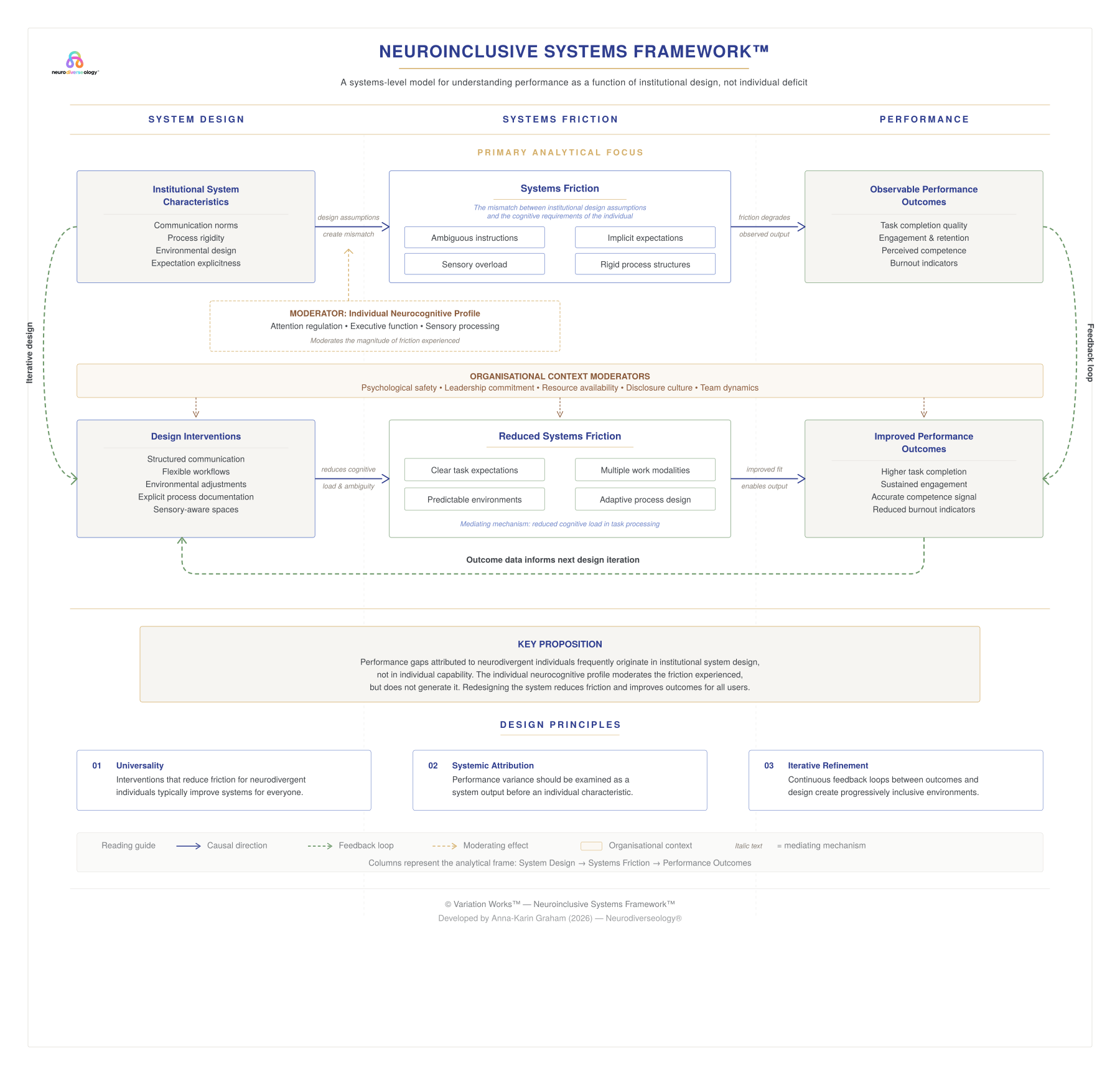

Figure 1. The Neuroinclusive Systems Framework™ illustrates how institutional system design creates cognitive demand, how mismatch produces systems friction, and how friction governs observable performance outcomes. Developed by Anna-Karin Graham (2026). Neurodiverseology®.
Why Neuroinclusive Workplace Design Is a Performance Architecture Problem
Workplace systems carry implicit cognitive demands. Every recruitment process, onboarding protocol, performance review cycle, and meeting structure imposes requirements on how individuals process information, interpret expectations, and signal competence. When those demands are aligned with how employees actually work, the system enables performance. When they are not, it generates systems friction: avoidable cognitive, procedural, and structural barriers that consume mental resources before the employee even begins the task.
For neurodivergent employees, this friction tends to be disproportionate. Not because of capability deficits, but because of what the Neuroinclusive Systems Framework™ identifies as cognitive demand mismatch: the disconnect between system-imposed demands and how individuals process, prioritise, and respond to information. The mismatch does not sit in the person. It sits in the process.
The Scale of the Problem
An estimated 15–20% of the global population is neurodivergent, yet unemployment rates for this group may be as high as 30–40%, approximately three times higher than for people with physical disabilities (Dunne, 2023). In the UK, just 31% of people with a neurodiversity condition are in employment, compared to 54.7% of disabled people overall (Department for Work and Pensions, 2025). Half of neurodivergent employees have taken time off work due to their condition, a figure that reflects workplace environments rather than individual impairment (City & Guilds, 2025).
These numbers do not describe a talent shortage. They describe a systems failure. Organisations are losing neurodivergent employees not because those employees cannot perform, but because the systems around performance, how work is communicated, how output is evaluated, how feedback is delivered, and how competence is signalled, were not designed with cognitive diversity in mind.
Where Workplace Systems Generate Avoidable Friction
The Neuroinclusive Systems Framework™ identifies five operational domains where workplace systems commonly generate friction for neurodivergent employees. Each domain corresponds to a structural mechanism that determines how cognitive work is organised, interpreted, and evaluated.
Recruitment and Selection Systems
Recruitment is often the first point of friction. Job descriptions loaded with vague competency language, such as “excellent communication skills,” “thrives in a fast-paced environment,” and “strong attention to detail,” do not describe the actual requirements of the role. They describe neurotypical behavioural norms that neurodivergent candidates may not recognise as relevant or may not present in the expected way during selection.
Interview formats compound the problem. Unstructured interviews favour candidates who can decode implicit social expectations, maintain eye contact, manage small talk, and demonstrate confidence through conventional signals. For neurodivergent candidates, these formats test social performance rather than job-relevant capability. Vargas-Salas et al. (2025) identified in their systematic review that neurodivergent individuals face persistent employment barriers rooted in stigma, negative employer associations, and selection processes that reward “traditional” traits unrelated to actual competency.
Neuroinclusive redesign targets these friction points directly: rewriting job descriptions to specify actual task requirements, offering structured interview formats with questions provided in advance, and providing alternative assessment methods such as work trials or portfolio reviews. Each change reduces the interpretive load on the candidate and increases the validity of the selection signal for the employer.
Onboarding and Workflow Systems
Onboarding processes that rely on social osmosis, learning by observation, informal conversations, and undocumented norms, create significant barriers for employees who process information differently. When the expectation is that new employees will “pick things up as they go,” the system is offloading cognitive labour onto the individual rather than embedding clarity into the process.
Workflow systems generate friction when task expectations are implicit, when handoff points between team members are undocumented, and when the process for escalating questions or concerns is unclear. For neurodivergent employees, each of these ambiguities represents an additional cognitive demand, not from the work itself, but from navigating the system around the work.
Deloitte’s research on building neuroinclusive workplaces found that creating a truly neuroinclusive organisation requires more than good hiring programmes. It requires a foundational reframing of how the organisation views work and teaming. Their interviews with HR executives, academics, and neurodivergent professionals identified that while policies supporting neurodivergent employees often exist, they are not always consistently applied, creating an equity gap between stated intent and operational reality (Deloitte, 2024).
Communication and Meeting Systems
Meeting structures represent a frequently overlooked source of workplace friction. Real-time verbal processing, rapid turn-taking, unstructured agendas, and decisions made through informal consensus all favour neurotypical communication styles. Neurodivergent employees, particularly those with ADHD, autism, or auditory processing differences, may find these formats cognitively demanding in ways that have nothing to do with their contribution quality.
Communication friction also accumulates through information architecture: when key decisions are communicated verbally without written follow-up, when updates are scattered across multiple platforms, or when the expected response time to messages is implicit rather than stated. Each of these patterns adds interpretive load, and for neurodivergent employees, that load compounds across every interaction.
Performance Evaluation and Feedback Systems
Performance reviews are one of the highest-friction mechanisms in any organisation. When evaluation criteria are vague, when different managers apply different interpretive frameworks, or when feedback is delivered as unstructured commentary rather than specific, actionable guidance, neurodivergent employees face a constant calibration problem: they cannot reliably determine what “good performance” looks like because the system keeps moving the target.
The concept of productivity signalling, the behaviours organisations interpret as indicators of performance, is particularly relevant here. Many organisations equate visibility, responsiveness, and social engagement with competence. Employees who work differently, who process deeply rather than quickly, who communicate in writing rather than verbally, and who produce excellent output without performing the expected social rituals, may be systematically undervalued by performance systems that measure signals rather than substance.
Hennekam et al. (2025) argued that neurotypical norms persist in occupational settings and that these norms generate inequalities affecting multiple stakeholder groups. Their analysis identified that performance systems built around implicit neurotypical assumptions create structural disadvantages that awareness alone cannot address.
Progression and Retention Systems
Progression pathways generate friction when the criteria for advancement are implicit, when sponsorship and visibility depend on informal networking, or when promotion decisions rely on subjective assessments of “leadership potential” that favour neurotypical behavioural profiles. Neurodivergent employees may meet or exceed output targets while remaining invisible to progression systems that reward social performance over task performance.
Retention is where the cumulative cost of systems friction becomes most visible. Research has consistently identified that neurodivergent employees experience higher rates of burnout, not from the work itself, but from the chronic effort of navigating systems that were not designed for them. Masking, the process of suppressing neurodivergent traits to conform with workplace norms, is mentally taxing and, over time, leads to exhaustion, disengagement, and departure (Vargas-Salas et al., 2025). A 2024 UK study on workplace masking found that increased intensity and regularity of masking was directly related to higher levels of exhaustion and faster burnout onset (CIPD, 2024).
Branicki et al. (2024) provided the first large-scale empirical evidence, using a nationally representative UK sample of over 25,000 people, that flexible and homeworking practices can moderate the employment disadvantages neurodivergent people experience. This finding reinforces the argument that outcomes are contingent on system conditions, not individual attributes. When the system changes, outcomes change.
For a detailed examination of how these friction patterns manifest specifically in higher education assessment environments, see Article 2 in this series.
The Diagnose → Design → Deploy → Demonstrate Approach for Organisations
The Neuroinclusive Systems Framework™ provides a structured methodology for auditing and redesigning workplace systems. It operates through a four-stage implementation loop that moves organisations from reactive accommodation to proactive system design.
Diagnose: Map Where Friction Occurs
The first step is identifying where systems friction is actually showing up, not where you assume it might be. Diagnosis involves mapping the cognitive demands embedded in recruitment processes, onboarding protocols, communication structures, performance evaluation methods, and progression pathways. It requires asking: where are employees spending cognitive resources navigating the system rather than performing within it?
The Neuroinclusive Systems Index™ Rapid Diagnostic Audit provides a structured entry point for this diagnostic process. While originally developed for assessment and feedback systems in higher education, its underlying methodology, measuring brief clarity, cognitive load, and feedback reliability, translates directly to organisational contexts. Task clarity maps to role expectations and workflow documentation. Cognitive load maps to information architecture and process complexity. Feedback reliability maps to performance review consistency and evaluation standardisation.
Design: Reduce Friction at the Source
Design interventions target the structural conditions that produce friction. They do not ask employees to adapt to poorly designed systems. They redesign the systems so adaptation is not required. Priority interventions include:
- Rewrite role expectations for specificity. Every role should have a documented set of core responsibilities, output expectations, and communication norms. If an employee needs to ask their manager what is expected of them, the system is generating friction at the point of instruction.
- Standardise feedback structures. Move from unstructured performance commentary to a consistent format: keep / stop / start with at least one specific next step. This reduces interpretive load and makes feedback actionable for all employees, not just those who can decode managerial subtext.
- Document decision rules for adjustments. Replace reactive, case-by-case accommodation processes with a published menu of available adjustments. This normalises support, reduces the disclosure burden, and ensures consistency across managers and teams.
- Redesign meeting structures for cognitive accessibility. Publish agendas in advance. Provide written summaries of decisions. Allow asynchronous input. These are not special accommodations. They are communication hygiene that improves clarity for everyone.
Deploy: Integrate Into Existing Operations
Deployment means embedding neuroinclusive design into existing operational systems rather than creating parallel processes. That includes training managers to apply standardised feedback structures, equipping HR teams to use diagnostic tools, and integrating friction metrics into existing quality assurance workflows. Applied accurately, improvements result in sustainable outcomes rather than being treated as one-off strategies.
Demonstrate: Track Friction Reduction With Lightweight Metrics
Organisations need evidence that redesign is working. The right metrics are not satisfaction scores alone. They are operational indicators of friction reduction: clarification request volume, onboarding time-to-productivity, feedback-related escalations, turnover rates among neurodivergent employees, and consistency of evaluation outcomes across managers.
These indicators already exist in most organisational systems. They just are not being framed as friction signals. Reframing them, and reporting them alongside engagement and retention data, gives leadership teams a clearer picture of where systems are working and where they are generating avoidable cost.
Why Neuroinclusive Systems Redesign Benefits the Entire Organisation
The universality principle holds within workplace contexts just as it does within education. Clearer role expectations assist all employees. Structured feedback supports all teams. Predictable adjustment pathways reduce anxiety across the workforce. Documented decision rules reduce managerial inconsistency. Accessible meeting structures improve participation and decision quality.
Neurodivergent employees encounter systems friction first and most acutely because of differences in how they process ambiguity, manage working memory, and navigate implicit expectations. But the underlying design flaws affect everyone. When organisations reduce cognitive demand mismatch, they do not just support neurodivergent employees. They build more effective operational environments that improve performance, retention, and decision quality across the board.
Rollnik-Sadowska and Grabińska (2024) concluded in their systematic review that integrating neurodiversity into sustainable human resource management practices can enhance innovation, employee satisfaction, and organisational reputation, reinforcing the argument that neuroinclusive redesign is a strategic investment, rather than a compliance cost.
Discovery Call
Identify where workplace systems are generating avoidable friction for neurodivergent talent.
Book a structured Discovery Call to diagnose high-friction points across recruitment, onboarding, communication, feedback, and progression systems, and prioritise the most effective redesign opportunities.
Frequently Asked Questions About Neuroinclusive Workplace Systems
What does neuroinclusive workplace design actually involve?
Neuroinclusive workplace design involves auditing and redesigning the structural systems that determine how work is communicated, evaluated, and performed, including recruitment, onboarding, communication, performance review, and progression processes. It focuses on reducing avoidable systems friction rather than adding individual accommodations after barriers have already been encountered.
How is this different from neurodiversity awareness training?
Awareness training increases understanding of neurodivergent experiences. Neuroinclusive systems redesign changes the operational conditions that generate barriers. A manager who understands ADHD but operates within an unstructured feedback system will still produce inconsistent performance signals. Systems redesign addresses the root cause, the system architecture, not just the knowledge of the people operating within it.
What is the business case for neuroinclusive systems redesign?
The business case operates on three levels. First, reduced friction lowers the hidden costs of clarification overload, rework, escalations, and turnover. Second, improved system clarity and consistency benefits all employees, not just neurodivergent ones, improving engagement and performance across the workforce. Third, organisations that retain neurodivergent talent gain access to cognitive diversity that drives innovation, pattern recognition, and problem-solving.
Where should an organisation start?
Start with the systems that have the most direct impact on day-to-day performance: performance evaluation and feedback, followed by onboarding and workflow documentation. These systems determine whether employees can reliably understand what is expected and whether they receive actionable signals about their performance. For a structured diagnostic, book a Discovery Call with Neurodiverseology® to identify where your systems are generating avoidable friction.
The Organisations That Win Will Be the Ones That Redesign
The neurodivergent talent pool is not small. It represents 15–20% of the population. And right now, a substantial proportion of that pool is either unemployed, underemployed, or burning out inside systems that were not designed to recognise their capability.
Awareness will not fix this. Awareness programmes do not rewrite job descriptions, standardise feedback loops, or document decision rules. They do not reduce the cognitive load of navigating an onboarding process that relies on observation rather than documentation. They do not make meeting structures accessible or progression criteria explicit.
Systems redesign does. And the organisations that commit to it will not just become more neuroinclusive. They will become more clearly documented, more consistently managed, and more effectively designed for every employee. That is the promise of neuroinclusive performance systems: workplaces that work for the workforce as it actually is, not the workforce a previous generation of systems assumed it would be.
References
Branicki, L. J., Brammer, S., Brosnan, M., Lazaro, A. G., Lattanzio, S., & Newnes, L. (2024). Factors shaping the employment outcomes of neurodivergent and neurotypical people: Exploring the role of flexible and homeworking practices. Human Resource Management, 63(6), 1001–1023. https://doi.org/10.1002/hrm.22243
CIPD. (2024). Neuro-inclusion at work report. Chartered Institute of Personnel and Development.
City & Guilds. (2025). Neurodiversity index 2025.
Deloitte. (2024). Building a neuroinclusive workplace. Deloitte Insights. https://www2.deloitte.com/us/en/insights/topics/value-of-diversity-and-inclusion/creating-neuroinclusive-workplace.html
Department for Work and Pensions. (2025). Employment of disabled people statistics. UK Government.
Dunne, M. (2023, November 28). Building the neurodiversity talent pipeline for the future of work. MIT Sloan Management Review. https://sloanreview.mit.edu/article/building-the-neurodiversity-talent-pipeline-for-the-future-of-work/
Hennekam, S., Kulkarni, M., & Beatty, J. E. (2025). Neurodivergence and the persistence of neurotypical norms and inequalities in educational and occupational settings. Work, Employment and Society, 39(2), 449–469. https://doi.org/10.1177/09500170241227360
Rollnik-Sadowska, E., & Grabińska, V. (2024). Managing neurodiversity in workplaces: A review and future research agenda for sustainable human resource management. Sustainability, 16(15), Article 6594. https://doi.org/10.3390/su16156594
Vargas-Salas, O., Alcazar-Gonzales, J. C., Fernández-Fernández, F. A., Molina-Rodríguez, F. N., Paredes-Velazco, R., & Carcausto-Zea, M. L. (2025). Neurodivergence and the workplace: A systematic review of the literature. Journal of Vocational Rehabilitation, 63(1), 83–94. https://doi.org/10.1177/10522263251337564