
The Neuroinclusive Systems Framework™
Redesigning organisational systems so neurodivergent capability can translate into measurable performance outcomes.
The Neuroinclusive Systems Framework™ is an applied systems model informed by psychological research and systems thinking. It conceptualises performance as a function of system design rather than individual deficit.
Rather than focusing solely on individual adjustments, the framework examines how organisational systems — including recruitment, assessment, workflow, communication, and progression — discerning how cognitive work is structured, interpreted, and evaluated.
At its core, the framework identifies a critical mechanism: cognitive demand mismatch — the mismatch between institutional design assumptions and the cognitive requirements of a neurodivergent individual.
When systems impose demands that require excessive interpretation, rely on implicit expectations, or introduce unnecessary complexity, this mismatch generates systems friction.
Performance gaps are therefore often not capability gaps — they are the outcome of systems friction arising from cognitive demand mismatch.
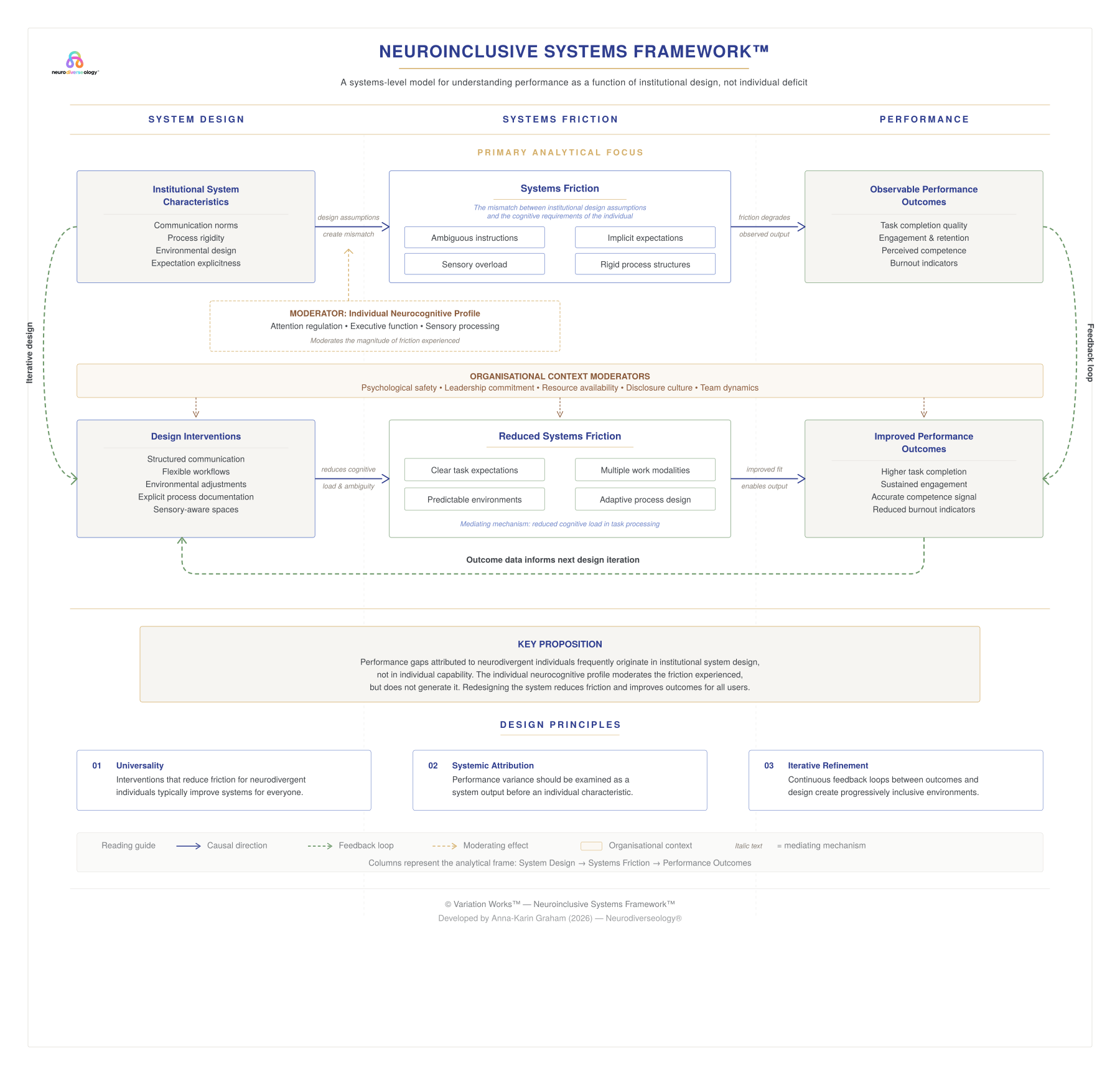
Figure 1. The Neuroinclusive Systems Framework™ illustrating how system design generates cognitive demand, how mismatch produces systems friction, and how friction governs observable performance outcomes.
The Neuroinclusive Systems Framework™ conceptualises performance as a function of system design rather than individual deficit. Instead of locating performance gaps within neurodivergent individuals, the framework examines how institutional processes, communication structures, and environmental conditions differentiate cognitive accessibility, engagement, and measurable outcomes.
Sources of systems friction include ambiguous instructions, implicit expectations, rigid process structures, and sensory or cognitive overload. These are not individual deficits. They are indicators of cognitive demand mismatch within system design.
By identifying and reducing these sources of friction, organisations can redesign systems to improve clarity, reduce unnecessary cognitive effort, and enable capability to translate more effectively into performance.
Framework Process
Diagnose → Design → Deploy → Demonstrate
Diagnose — Identify where system design creates cognitive demand mismatch, systems friction, or inconsistent performance conditions.
Design — Redesign processes, expectations, and workflows to improve clarity, reduce ambiguity, and align cognitive demands with how work is processed and performed.
Deploy — Implement structural improvements within organisational systems, communication practices, and operational routines.
Demonstrate — Evaluate whether redesigned systems reduce friction and improve clarity, capability utilisation, and measurable performance outcomes.
Where the Framework Applies
The framework focuses on organisational systems that discern how cognitive work is structured and evaluated across both Higher Education and workplaces.
Recruitment Systems
Hiring processes, interview structures, and selection methods that determine access to opportunity.
Assessment & Evaluation Systems
Grading structures, performance reviews, and feedback processes that define how capability is recognised.
Productivity & Workflow Systems
Task design, workload structures, and productivity signals that govern how work is performed.
Communication & Meeting Systems
Information flow, collaboration structures, and meeting practices that influence participation and decision-making.
Progression & Retention Systems
Promotion pathways, development structures, and retention dynamics that define long-term capability utilisation.
Analytical Approaches
Systems are analysed through a set of diagnostic approaches grounded in psychological research and systems thinking.
Systems Friction
Barriers created when system design introduces unnecessary effort, ambiguity, or interpretive demand.
Cognitive Demand
The mental requirements imposed by system structures, task design, and information flow.
Cognitive Demand Mismatch
The mismatch between system-imposed demands and how individuals process, prioritise, and respond to information.
Cognitive Load
The total mental effort required to interpret, manage, and complete tasks within a system.
Productivity Signalling
The behaviours organisations interpret as indicators of performance, such as responsiveness, visibility, or output patterns.
Cognitive Fit
The degree of alignment between cognitive strengths and system demands.
Hidden Cognitive Labour
The unrecognised mental effort required to navigate unclear expectations, fragmented systems, or inconsistent processes.
Why Systems Design Matters
Many initiatives focus on awareness or individual support. While valuable, these approaches often leave underlying systems unchanged.
When organisational systems remain structured around implicit norms, inconsistent expectations, or high interpretive demand, cognitive demand mismatch persists — and with it, systems friction. The Neuroinclusive Systems Framework™ therefore focuses on structural redesign, not individual adjustment alone.
Flagship Application
The first applied model within this work is the Neuroinclusive Assessment & Feedback Systems Framework™.
Assessment and feedback systems are among the most influential structural mechanisms in both universities and workplaces. They determine how expectations are interpreted, how capability is evaluated, and how performance signals are produced.
When briefs, rubrics, feedback practices, or adjustment pathways lack clarity or consistency, they create cognitive demand mismatch — increasing systems friction and introducing interpretive uncertainty.
Diagnose friction → Redesign the system → Demonstrate impact
This applied loop enables organisations to identify friction points, implement structural improvements, and evaluate whether clarity, consistency, and measurable outcomes improve.
Applying the Framework
The Neuroinclusive Systems Framework™ provides a structured approach to analysing systems, identifying cognitive demand mismatch, and guiding targeted redesign.
Its objective is clear: reduce systems friction so that capability can translate into measurable performance outcomes.