
Across higher education and workplace environments, the same pattern appears repeatedly. Students miss deadlines because instructions are buried in dense briefs with no clear output format. Employees receive contradictory feedback and are then assessed for inconsistency. Talented professionals burn out, not because they cannot do the work, but because they expend too much cognitive effort working out what the system expects.
These are not isolated individual failures. They are system failures. Until institutions recognise that, awareness training alone will not close the neuroinclusive performance gaps that neurodivergent people continue to experience.
This article establishes systems friction as a primary analytical lens for understanding why neuroinclusive performance gaps persist and what organisations can do about them. Grounded in cognitive load research, applied psychology, and the Neuroinclusive Systems Framework™, it argues that performance is best understood as a function of system design rather than individual deficit.
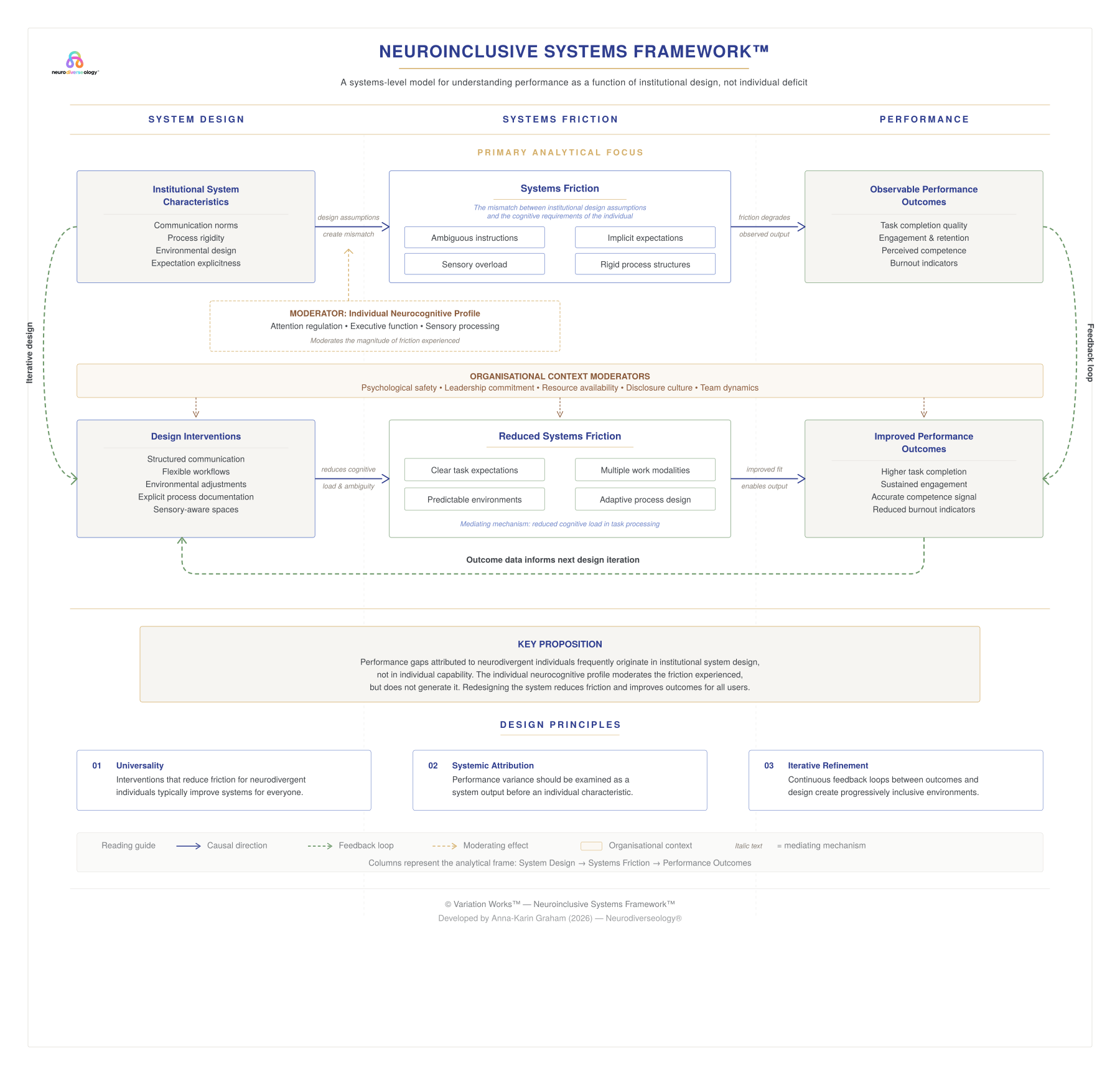
Figure 1. The Neuroinclusive Systems Framework™ illustrates how institutional system design creates cognitive demand, how mismatch produces systems friction, and how friction governs observable performance outcomes. Developed by Anna-Karin Graham (2026). Neurodiverseology®.
What Is Systems Friction and Why Does It Matter for Neuroinclusive Design?
Systems friction refers to avoidable cognitive, procedural, and structural barriers that emerge when institutional design assumptions do not align with how people process information, interpret expectations, and produce work. It is the gap between what a system demands and what it clearly communicates. For neurodivergent people, including those with ADHD, autism, dyslexia, and dyspraxia, that gap is often wider, more frequent, and more consequential.
The term matters because it redirects analysis away from the individual and toward the institutional conditions that produce performance outcomes. When a neurodivergent employee struggles to meet expectations, the conventional response is: “What is wrong with this person?” A systems friction analysis response is: “What is wrong with this process?”
The Cognitive Demand Mismatch Problem
At the centre of systems friction sits a mechanism that the Neuroinclusive Systems Framework™ identifies as cognitive demand mismatch. This is the disconnect between the cognitive demands a system imposes and how an individual processes, prioritises, and responds to information. Every organisational process carries implicit cognitive requirements: interpreting ambiguous instructions, holding multiple expectations in working memory, switching between tasks without explicit transition cues, or decoding unstated social norms built into evaluation criteria.
When those demands exceed what is necessary for the task itself, systems friction increases. The individual spends mental resources navigating the system rather than performing within it. For neurodivergent people, whose executive function profiles may differ in attention regulation, working memory, sensory processing, or processing speed, this mismatch can generate disproportionate friction.
When the process is harder than the work, systems friction is present.
This does not mean neurodivergent people cannot perform. It means the system is consuming cognitive resources that should be directed toward the task itself. For a fuller explanation of how this mechanism operates across system design, systems friction, and performance outcomes, see the Neuroinclusive Systems Framework™.
How Institutional Systems Create Avoidable Performance Barriers
Institutions rarely intend to create barriers. Yet the standard operating procedures of most universities and employers were built around a narrow set of cognitive assumptions: assumptions about how people read instructions, manage time, respond to feedback, and signal competence. When these assumptions remain unexamined, they produce structural friction that compounds over time.
Hidden Expectations and Ambiguous Task Design
One of the most common sources of systems friction is task ambiguity. In higher education, assessment briefs often omit critical information such as the expected output format, the weighting of criteria, or the standard an exemplar is intended to demonstrate. Students are left to infer these details from context, prior experience, or informal guidance, none of which is reliably accessible to neurodivergent learners.
Research from Le Cunff et al. (2024a) found that neurodivergent students experience significantly higher extraneous cognitive load than neurotypical peers, and that the increase stems primarily from how learning material is presented rather than from its inherent difficulty. In practical terms, the friction is not in the content. It is in the delivery system. When instructions lack structure, curricula are unclear, and expectations remain implicit, students spend additional mental effort simply trying to work out what they are supposed to do.
The same pattern appears in workplace settings. Job descriptions filled with vague requirements such as “excellent communication skills” or “works well under pressure” do not describe competencies with any precision. They often reflect neurotypical behavioural norms. Onboarding processes that rely on observation and social osmosis rather than explicit documentation create unnecessary barriers for staff who process information differently.
Inconsistent Feedback and Evaluation Practices
Feedback systems represent another high-friction zone. When evaluation criteria are not standardised, when different evaluators apply different interpretive frameworks, or when feedback arrives late and without actionable structure, the performance loop breaks down.
For neurodivergent people, inconsistent feedback creates a particular problem. It removes the predictability needed to calibrate future performance. If one manager rewards initiative while another penalises deviation from procedure, the employee is left with a constant interpretive burden: trying to decode which set of rules applies in which context. This is not a skill deficit. It is a system design failure.
Research on managing neurodiversity in workplaces has consistently identified that organisations lack integrated solutions for reducing turnover and improving employment outcomes among neurodivergent employees (Rollnik-Sadowska & Grabińska, 2024). The evidence points toward system-level interventions rather than individual coaching as the more effective route.
This institutional pattern is examined in more detail in Article 2, which focuses specifically on how systems friction appears within higher education assessment environments.
The Evidence: Cognitive Load, Neurodivergent Learners, and Workplace Outcomes
The relationship between cognitive load and neurodivergent performance has attracted growing research attention, particularly in higher education. The evidence supports a clear proposition: when systems impose unnecessary cognitive demands through poor design, neurodivergent people absorb a disproportionate share of the resulting friction.
What the Research Tells Us About Extraneous Cognitive Load
Cognitive load theory, originally developed by Sweller (1988), distinguishes between three forms of mental effort: intrinsic load, which reflects the inherent difficulty of the material; extraneous load, which reflects the effort imposed by presentation and delivery; and germane load, which reflects effort invested in building understanding. For neuroinclusive system design, extraneous cognitive load is the critical variable because it is the one institutions can control.
A 2024 quantitative study involving 231 higher education students found that neurodivergent participants reported significantly higher extraneous cognitive load in online learning environments than neurotypical peers (Le Cunff et al., 2024b). Importantly, intrinsic and germane load did not differ between groups. The difficulty of the material was not the problem. The way the system delivered that material was.
ADHD traits emerged as a particularly significant predictor of elevated extraneous cognitive load. This has direct implications for how institutions structure task briefs, assessment workflows, and information architecture. Qualitative research from the same team also found that neurodivergent students encountered additional barriers from inaccessible content presentation, unclear curricula, and fragmented navigation, all of which are system design variables rather than individual characteristics (Le Cunff et al., 2024a).
In workplace contexts, the data is equally significant. Estimates suggest that unemployment rates for neurodivergent adults may be as high as 30–40%, approximately three times higher than for people with physical disabilities and eight times higher than for the general population (Dunne, 2023). While precise figures vary by condition and region, the pattern remains consistent across data sources. The UK Office for National Statistics (2021) reported that autistic adults have the lowest employment rate of any disability group, with only 21.7% in employment. These figures do not reflect a lack of capability. They reflect systems that were not designed to recognise or enable neurodivergent talent.
Branicki et al. (2024) provided large-scale empirical evidence that flexible and homeworking practices can moderate the employment disadvantages neurodivergent people experience. This further supports the argument that outcomes are contingent on system conditions rather than individual attributes.
Moving From Awareness to Neuroinclusive Systems Redesign
Awareness has dominated the neuroinclusion conversation for more than a decade. Organisations invest in neurodiversity training, host awareness weeks, and add inclusive language to policy documents. These efforts have value, but they do not change the systems that generate friction. A manager may understand that ADHD affects executive function, but still operate within a feedback system that is inconsistent, delayed, and unstructured. A university may acknowledge dyslexia, but still issue assessment briefs that require students to decode implicit expectations from dense text.
The transition from awareness to redesign requires a different operating model, one grounded in diagnosing where friction occurs and implementing structural changes that reduce it.
The Diagnose → Design → Deploy → Demonstrate Approach
The Neuroinclusive Systems Framework™ operationalises this transition through a four-stage implementation loop:
- Diagnose – Identify where system design creates cognitive demand mismatch, systems friction, or inconsistent performance conditions. This includes mapping task clarity, feedback reliability, adjustment pathways, and communication structures.
- Design – Redesign processes to improve clarity, reduce ambiguity, and align cognitive demands with how work is actually processed and performed. This includes standardised templates, feedback structures, decision rules, and scaffolded workflows.
- Deploy – Implement structural improvements within existing organisational systems, supporting staff enablement and operational integration rather than introducing parallel processes.
- Demonstrate – Evaluate whether redesigned systems reduce friction using lightweight metrics such as clarification volume, rework rates, escalation frequency, and experience indicators from both neurodivergent people and the staff who support them.
This approach reframes neuroinclusion as a performance architecture challenge. It does not ask people to adapt to poorly designed systems. It asks institutions to build systems that enable performance in the first place.
Practical Entry Points for Higher Education and Organisations
For institutions looking to begin, assessment and feedback systems offer the highest-leverage starting point. These systems determine how expectations are communicated, how capability is evaluated, and how performance signals are generated. When they are unclear, they create friction. When they are redesigned for clarity and consistency, they reduce friction for everyone.
Practical starting points include:
- Audit task briefs for completeness. Does every brief state the purpose, task, output format, weighting, word count, and submission method on a single page? If not, friction is being generated at the point of instruction.
- Standardise feedback structures. Move from unstructured commentary to a keep / stop / start format with at least one specific next step. This reduces interpretive load and increases actionability.
- Publish adjustment menus. Replace reactive, case-by-case adjustment processes with a published menu of common options available to all. This normalises support and reduces disclosure burden.
- Provide annotated exemplars. At least one example demonstrating the expected standard should accompany every assessment or performance task. Exemplars reduce guesswork and the cognitive labour of interpreting abstract criteria.
Each of these interventions targets a specific source of extraneous cognitive load, and each can be measured using simple before-and-after indicators. Practical redesign in organisational settings is developed further in Article 3, which focuses on audit and implementation in the workplace.
Why Neuroinclusive System Design Benefits Everyone
One of the most consistent findings across neuroinclusive design research is the universality principle: interventions that reduce friction for neurodivergent people typically improve systems for everyone. Clearer briefs help all students. Structured feedback supports all employees. Predictable processes reduce uncertainty more broadly.
This is not accidental. Systems friction affects all users of any educational or organisational system. Neurodivergent people often encounter it earlier and more intensely because of differences in how they process ambiguity, manage working memory, and navigate implicit expectations. As Le Cunff et al. (2024a) noted in their qualitative findings, neurotypical and neurodivergent students face similar challenges in navigating cognitive load; the difference is one of intensity rather than kind.
The universality principle has a strategic implication for institutional leaders. Neuroinclusive redesign is not a special-interest accommodation. It is a system performance improvement. Organisations that reduce cognitive demand mismatch do not just support neurodivergent people. They build clearer, more consistent, and more effective operating environments.
Hennekam et al. (2025) reinforced this position by arguing that neurotypical norms persist in educational and occupational settings and generate inequalities affecting multiple stakeholder groups, not only those who identify as neurodivergent.
Measuring Systems Friction: From Subjective Experience to Diagnostic Tools
One barrier to institutional adoption of neuroinclusive redesign has been the perceived difficulty of measurement. If systems friction is the problem, how should it be quantified? And how should improvement be demonstrated to leadership teams that require evidence before committing resources?
The answer lies in lightweight, operationally embedded metrics. Systems friction leaves observable traces in any organisation: the volume of clarification requests submitted before a deadline, the number of feedback-related escalations or disputes, the rate at which tasks require rework, and the consistency of evaluation outcomes across different assessors.
The Neuroinclusive Systems Index™ Rapid Diagnostic Audit, developed under the Neuroinclusive Systems Framework™, provides a structured entry point for this kind of measurement. It assesses 12 system-level indicators across three domains: brief clarity, cognitive load and accessibility, and feedback system reliability. It then produces a mean score that categorises institutional systems as high, moderate, or low friction environments.
This diagnostic approach allows organisations to establish a baseline, prioritise the highest-friction areas, and track whether structural changes produce measurable improvement. It shifts the conversation from “Are we neuroinclusive?” to “Where is our system generating avoidable friction, and what is the cost?”
For institutions seeking a practical starting point, a Discovery Call with Neurodiverseology® provides a structured method for identifying where systems friction is showing up and which interventions will produce the greatest return on clarity, consistency, and performance outcomes.
Discovery Call
Identify where systems friction is undermining clarity, consistency, and performance.
Book a structured Discovery Call to pinpoint high-friction processes and prioritise the most effective redesign opportunities.
Frequently Asked Questions About Neuroinclusive Systems Friction
What is systems friction in a neuroinclusive context?
Systems friction refers to avoidable cognitive, procedural, and structural barriers that arise when institutional processes do not align with how people, particularly neurodivergent people, process information, interpret expectations, and produce work. It is a function of system design rather than individual capability.
How does systems friction differ from individual accommodation?
Individual accommodation addresses the needs of a specific person after a barrier has been identified. Systems friction analysis works upstream. It identifies where the system itself generates barriers and redesigns the process so fewer individual accommodations are needed.
Can systems friction be measured?
Yes. Systems friction leaves observable traces such as clarification request volume, feedback escalation rates, rework frequency, evaluator variance, and experience indicators from both neurodivergent people and the staff who support them. Tools such as the Neuroinclusive Systems Index™ Rapid Diagnostic Audit provide a structured method for quantifying friction across task clarity, cognitive load, and feedback reliability.
Does neuroinclusive redesign only benefit neurodivergent people?
No. Research consistently shows that reducing extraneous cognitive load and improving system clarity benefits all users. Neurodivergent people tend to encounter friction sooner and more intensely, but the underlying improvements, such as clearer instructions, structured feedback, and predictable processes, improve outcomes more broadly.
Where should an organisation start when addressing systems friction?
Assessment and feedback systems offer the highest-leverage starting point. These systems determine how expectations are communicated, how capability is evaluated, and how performance signals are produced. A practical first step is to audit task briefs, standardise feedback structures, and clarify adjustment pathways. For a structured starting point, book a Discovery Call.
It Is Time to Redesign the Systems, Not the Individual
Performance gaps attributed to neurodivergent people do not originate in the individual. They originate in the systems those individuals are expected to navigate. Until institutions shift their focus from individual remediation to structural redesign, those gaps will persist.
Systems friction is not inevitable. It is a design choice, often an unconscious one, but a choice nonetheless. Every ambiguous brief, every unstructured feedback loop, and every implicit expectation is a point at which friction enters the system and capability is lost.
The evidence is clear. The framework exists. The diagnostic tools are available. What remains is institutional willingness to ask a better question: not “Why can’t this person perform?” but “What in our system is preventing performance?”
Institutions that answer that question do not just become more neuroinclusive. They become better designed, better performing, and better positioned to retain the talent they cannot afford to lose. That is where neuroinclusive performance begins: not with deficit thinking, but with friction reduction.
References
Branicki, L. J., Brammer, S., Brosnan, M., Lazaro, A. G., Lattanzio, S., & Newnes, L. (2024). Factors shaping the employment outcomes of neurodivergent and neurotypical people: Exploring the role of flexible and homeworking practices. Human Resource Management, 63(6), 1001–1023. https://doi.org/10.1002/hrm.22243
Dunne, M. (2023, November 28). Building the neurodiversity talent pipeline for the future of work. MIT Sloan Management Review. https://sloanreview.mit.edu/article/building-the-neurodiversity-talent-pipeline-for-the-future-of-work/
Hennekam, S., Kulkarni, M., & Beatty, J. E. (2025). Neurodivergence and the persistence of neurotypical norms and inequalities in educational and occupational settings. Work, Employment and Society, 39(2), 449–469. https://doi.org/10.1177/09500170241227360
Le Cunff, A.-L., Dommett, E. J., & Giampietro, V. (2024a). Neurodiversity and cognitive load in online learning: A focus group study. PLOS ONE, 19(4), Article e0301932. https://doi.org/10.1371/journal.pone.0301932
Le Cunff, A.-L., Dommett, E. J., & Giampietro, V. (2024b). Neurodiversity positively predicts perceived extraneous load in online learning: A quantitative research study. Education Sciences, 14(5), Article 516. https://doi.org/10.3390/educsci14050516
Le Cunff, A.-L., Dommett, E. J., & Giampietro, V. (2024c). Cognitive load and neurodiversity in online education: A preliminary framework for educational research and policy. Frontiers in Education, 9, Article 1437673. https://doi.org/10.3389/feduc.2024.1437673
Office for National Statistics. (2021). Outcomes for disabled people in the UK: 2021. https://www.ons.gov.uk/peoplepopulationandcommunity/healthandsocialcare/disability/articles/outcomesfordisabledpeopleintheuk/2021
Rollnik-Sadowska, E., & Grabińska, V. (2024). Managing neurodiversity in workplaces: A review and future research agenda for sustainable human resource management. Sustainability, 16(15), Article 6594. https://doi.org/10.3390/su16156594
Sweller, J. (1988). Cognitive load during problem solving: Effects on learning. Cognitive Science, 12(2), 257–285. https://doi.org/10.1207/s15516709cog1202_4